By Dr. Sushree Sangita Mohanty
Founding Director, Ekkathaa Foundation
Some journeys don’t just change your location—they change the way you carry time and memory. My visit to Queensland, staying with Rae, John, and their wild-hearted dog, Chaos, was one of those rare, soul-stirring weeks. It unfolded not like a typical trip, but more like a living seminar in slowness—layered with learning, laughter, stories, and quiet wonder.
On the very first evening, as we walked along the soft trails of Oxley Creek, something shifted. The air smelled of eucalyptus and dusk. The creek curved gently, almost as if inviting us to listen. There was no rush, no pressure to arrive—just a rhythm I had forgotten I needed. The land felt like it was holding me, and I let it.
One of the days that carved itself into my heart was our walk through Maiala in D’Aguilar National Park. Andreas, our guide, moved with patience and curiosity, teaching me how to listen to the forest—how to spot catbirds by sound, how to follow a flicker in the trees with intention. Each bird became a tiny revelation, a reminder that attention is a form of love.
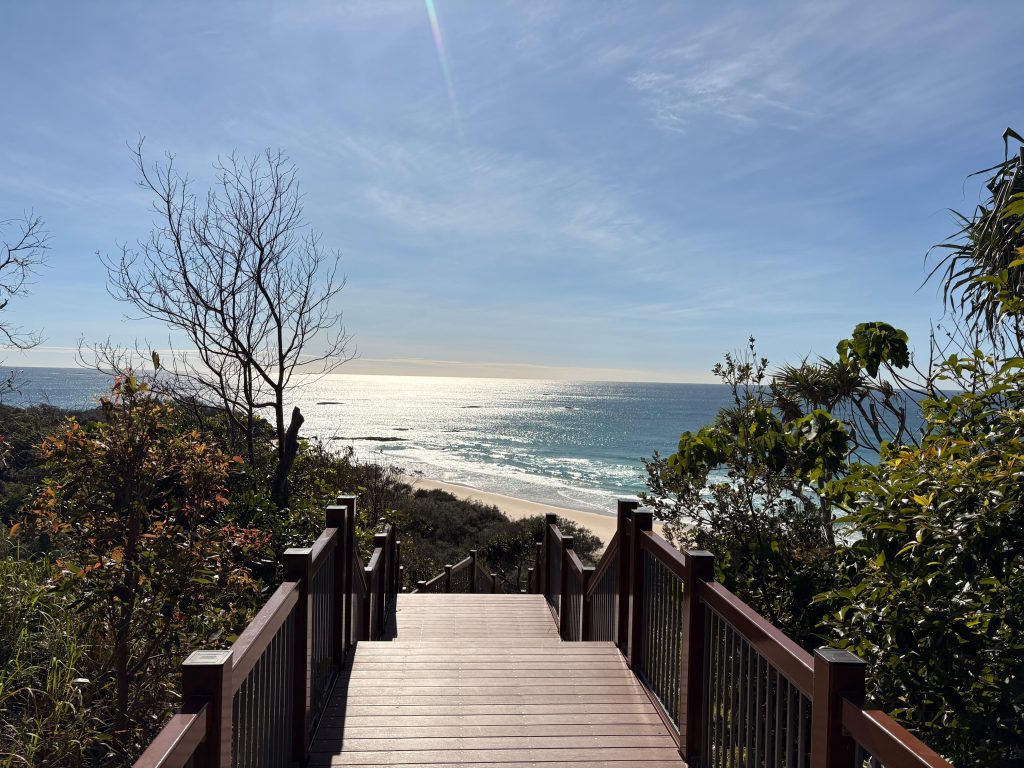
Then came my first ferry ride, across water that shimmered like brushed silver, to North Stradbroke Island (Minjerribah). There was something sacred in that crossing. At the Stradbroke Island Museum, Elizabeth and Jenevee didn’t just show us exhibits—they shared stories, with humour and depth that stayed with me. The past wasn’t static here; it was alive, spoken, remembered. It felt like stepping into a woven tapestry of place, people, and persistence.
We also spent a morning at the Mt Coot-tha Botanic Gardens, and I remember entering the Tropical Dome as if I were stepping into another world. Dense, alive, breathing—a microcosm of everything we’re a part of and everything we so often forget we’re connected to. The fragility of it stayed with me.
One evening, over a dinner of rice, curry, and broccoli, stories unfolded—of journeys, losses, lands. We laughed and listened, as the soft glow of candlelight flickered against walls filled with family photos. It was the kind of meal that feeds you in more ways than one.
And then there was Chaos—dear, chaotic Chaos. He greeted kangaroos with mad joy, darted toward roads with terrifying speed, and curled up with the gentleness of a child. I’ll never forget the moment I ran after him, heart pounding, instincts firing. In that moment, I realised how deeply I had come to care for him. He wasn’t just a dog on the trip—he was part of the memory.
On another day, I stood beside Rae during her weekly climate action ritual—a silent wave for the Earth, for justice, for future generations. No big crowds, no microphones. Just intention, stillness, and presence. It moved something in me. It reminded me that change often begins in quiet, consistent acts.
Our final day at the Queensland Museum was like walking through layers of stories—some told out loud, others held in silence. I’m deeply thankful to Heider, Imelda, and the team who opened up space for reflection and dialogue. It wasn’t just about artefacts; it was about presence, legacy, and shared responsibility.
And throughout the week, there were conversations—with Rae, John, and their friends—that lingered long after the words were spoken. Discussions about Bran Nue Dae unfolded into deeper reflections on identity, resistance, humour, and what it means to belong. Each voice added to a slow, thoughtful weaving—of histories, of cultural worlds, of ethical listening.
I left with a heart full. Not just with memories, but with a renewed sense of attention—to land, to stories, to people. This wasn’t a holiday. It was a turning point.